4 min read
Virgin Media O2 cuts campaign build time from hours to seconds with BrazeAI Operator™
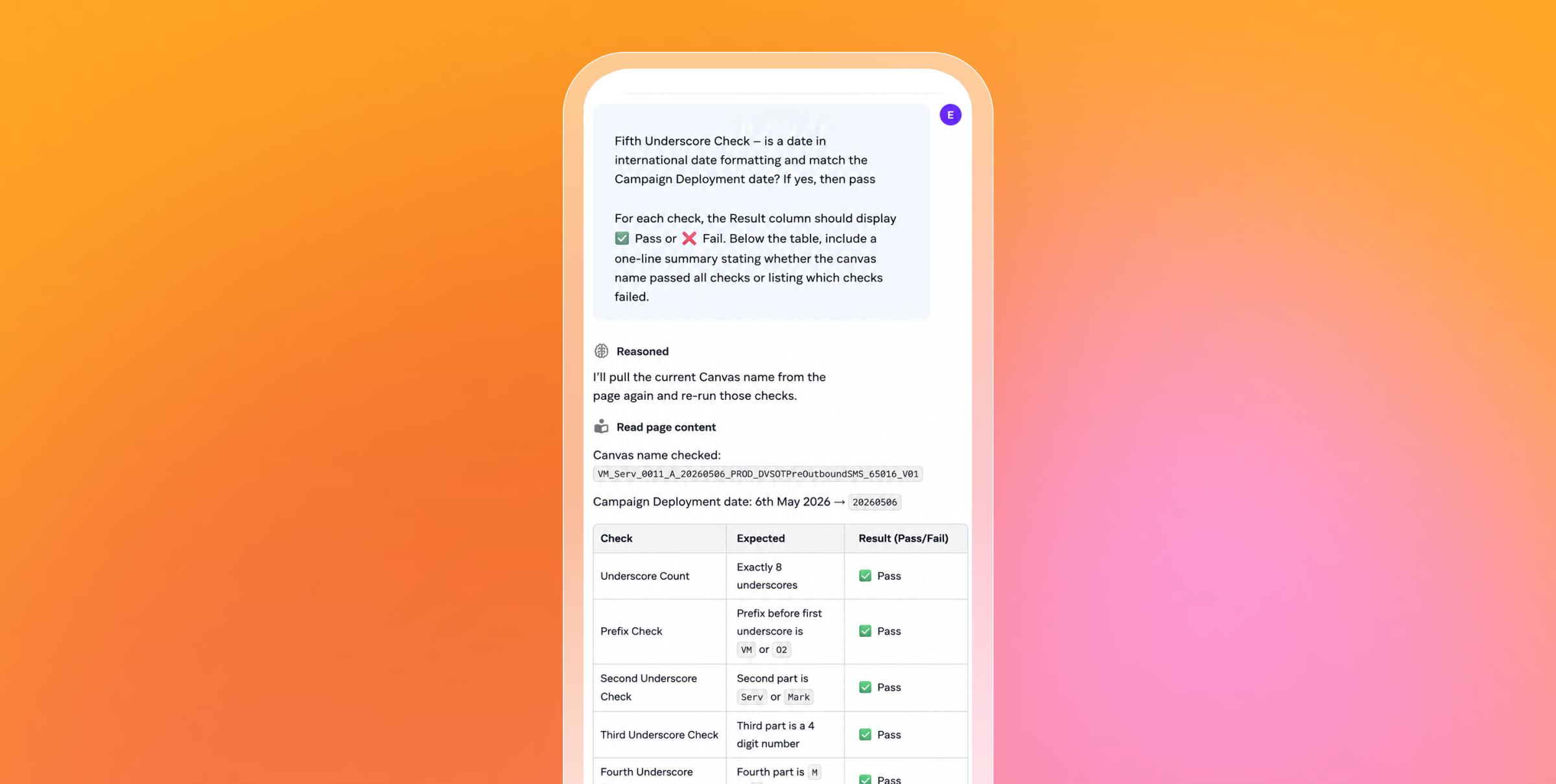
As Virgin Media O2's campaign programs grew in complexity, their QA process struggled to keep pace. Checking hundreds of elements across large campaigns was manual, time-consuming, and could be error-prone. Individual QA documents could take up to six hours to complete. Repeated build iterations compounded the problem, with some campaign updates requiring two full days of rework.
The team adopted BrazeAI Operator™ to automate complex QA checks across campaigns and Canvases. What began as a targeted fix quickly expanded: Operator became a daily tool for writing SQL and Liquid, trying out new Braze capabilities like Catalogs, and answering “How do I…?” questions as they came up.
QA tasks that previously took hours now complete in seconds. Campaign builds that required two days of iteration now take approximately 15 minutes. The team has moved from spreadsheet-based QA docs to AI-driven validation at scale—and a cultural shift has followed, with strong engagement, healthy competition, and a growing pipeline of AI-led innovations.
INDUSTRY
PRODUCTS USED
BY THE METRICS
From 6 hours to seconds
Campaign QA time (per Canvas)
From 2 days to 15 min
Campaign build iteration time
From months to hours
New feature learn-to-launch cycle (e.g. in-app surveys)
Virgin Media O2 is one of the UK's leading telecommunications providers, formed through the merger of Virgin Media and O2 in 2021. From a customer engagement perspective, the company operates large-scale, multi-channel marketing programs across millions of customers, which makes campaign accuracy, speed, and consistency business-critical requirements. Virgin Media O2’s customer relationship management (CRM) and campaign team runs complex Braze Canvases spanning dozens of messages, URLs, and configuration elements—each of which requires thorough QA before launch.
The time-consuming task of balancing quantity with quality
As campaign complexity grew, so did the burden of quality assurance. A single customer journey (built via Canvas) might contain 50 or more messages and over 150 individual elements requiring manual verification—from campaign naming conventions and segment membership to UTM tags and deployment date formatting. Managing this process was both difficult and time-consuming, especially across large builds. The team maintained detailed QA spreadsheets, but these documents could take up to six hours to complete.
Beyond QA, repeated campaign iterations created a second drain on resources. Build processes that required regular updates, such as product or catalogue-based campaigns, could absorb two full days of effort per iteration. Teams also relied heavily on internal experts and Braze support documentation for guidance on new features, which led to slowed delivery.
Putting AI to the test using BrazeAI Operator™
The team's entry point into AI was a simple test: Could BrazeAI Operator™ replicate a manual QA check that had previously taken approximately six hours? The prompt completed in around ten seconds, correctly identifying the issue. This set the direction for everything that followed.
The team started using BrazeAI Operator™ to cross-check Canvas elements and build scripts for QA automation. They soon moved from Operator just checking settings to providing end-to-end build validation.
Today, Operator is the team’s go-to tool for writing SQL and Liquid, exploring unfamiliar Braze features, and getting instant answers to process questions without waiting on internal support. For example, when the team needed to adopt Catalogs, Operator guided them through the learning and implementation process in a single session, reducing what had been a two-day build to approximately 15 minutes.
Building AI initiatives and ownership into OKRs
To embed AI sustainably, the team's leadership built a structured operating model around it. OKRs were designed to ladder from individual contributors up to leadership, with each team member owning a defined initiative—such as implementing Catalogs, Figma integrations, or templating improvements—and contribute to shared, measurable outcomes.
Recurring “Show & Tell” sessions also encouraged team members to present their AI-driven innovations to peers, creating a culture of knowledge-sharing, experimentation, and healthy competition. The team’s intentional approach—tying AI use to clear problem statements—was a large part of their success.
Time-savings and precision at an unprecedented speed
Virgin Media O2’s AI adoption via Braze has led to a massive QA and campaign build transformation. QA that previously consumed up to 6 hours now runs in seconds, enabling the team to launch large, complex campaigns with confidence. Build efficiency has followed a similar trajectory—campaign iterations that required two days of effort now take approximately 15 minutes, with Catalog-based structures enabling reusable content blocks that reduce repeated work across recurring campaigns.
There are also time savings when it comes to the team learning new capabilities in Braze. Capabilities that might have taken months to evaluate and deploy (e.g., in-app surveys), can now be learned, built, tested, and launched within hours.
The team’s experience and success with BrazeAI Operator™ adds up to measurable business outcomes, but also has led to a cultural shift, where there’s excitement around skill development and experimentation. Moving forward, the team is planning a prompt optimization workshop and is looking towards advanced automation as part of their ongoing OKR roadmap.
BrazeAI Operator™ reduced our campaign QA and build effort in some cases from hours to seconds or from days to minutes, while simultaneously increasing team capability, speed, and innovation—fundamentally changing how marketing is delivered.

Benjamin Gibson
CRM Platform Operations Manager, Virgin Media O2 Business Key Takeaways
Test with a real problem
The team used a real pain point, a use case that exemplified how they were bogged down in granular, manual QA tasks. By identifying a clear challenge with measurable outcomes—using just one project—they gained an immediate proof point to support broader experimentation.
AI productivity gains also help accelerate skill development
BrazeAI Operator™ functions as a real-time knowledge tool, enabling team members to learn new Braze capabilities and build skills independently. This reduces reliance on internal experts and compresses the time between identifying a new capability and putting it into production.
Leadership investment encourages adoption
Laddered OKRs with and regular individual ownership of AI initiatives, tied to shared team goals, created both accountability and competitive energy. Paired with “Show & Tell” sessions, this provided the team with a framework for embedding AI into their operating model and encouraged AI use as a cultural habit, where everyone can learn from one another’s missteps and successes.
FEATURED TOPICS
Check out more Case Studies
 Case Study3 min read
How BookBeat cut days of cross-market reporting to minutes with the Braze MCP Server
 Case Study3 min read
Klover turned a testing plateau into its biggest open-rate wins with Braze Content Optimizer
 Case Study3 min read
Uswitch turns AI-optimized subject lines and CTAs into a smarter path to smart meter connections