Beyond abandoned cart emails: How AI decisioning helps retail brands build loyalty
Published on April 22, 2026/Last edited on April 22, 2026/15 min read

Team Braze
Contents
Around 70% of online shopping carts are abandoned before checkout. That's a significant pool of high-intent shoppers who browsed, chose something, and left. Most brands respond with abandoned cart emails. A short automated sequence reminding them what they left behind.
Those emails work. They're triggered by customer behavior, relatively easy to deploy, and consistently outperform broadcast campaigns on engagement and conversion. But they operate on a single assumption, that everyone who walked away did so for the same reason and will respond to the same nudge. That’s not true.
In this article we look at how retail and eCommerce brands can move away from a reactive path, where batch emails and blanket discounts are common. With AI decisioning, brands can build 1:1 engagement, optimize continuously for the best outcome, and strengthen customer loyalty over time.
TL;DR
- Around 70% of online shopping carts are abandoned, and most brands respond with the same batch email sequence regardless of why the customer left.
- AI decisioning replaces fixed rules with individual-level decisions, selecting the right channel, message, timing, and offer for each customer.
- The same system that recovers abandoned carts can drive repeat purchase, detect loyalty signals, and reduce future abandonment.
- Choosing the right platform means understanding what type of AI strategies is uses, such as reinforcement learning, which selects from a range of possible actions, observes what happens, receives a signal when it hits the target, and updates its decision policy accordingly.
Key takeaways
- Blanket discount sequences erode margin by incentivising customers who would have converted anyway.
- AI decisioning is not next best action. It optimises across every dimension simultaneously—channel, message, creative, timing, frequency, and offer depth—at the individual level.
- Post-purchase engagement is where the loyalty relationship is built or lost. AI decisioning treats conversion as the beginning of the next decision, not the end of the journey.
- Cart recovery is a moment, not a strategy. The brands building durable customer relationships are using decisioning across the full lifecycle.
- Data readiness is the foundation. Inconsistent event tracking, siloed customer data, and unclear KPIs limit what any decisioning system can do.
What are abandoned cart emails and why do brands use them?
An abandoned cart email is an automated message sent to a shopper who adds items to an online cart but leaves without completing the purchase. These messages are event-triggered, typically rule-based, and run as a short sequence of 2 to 3 emails delivered over 48 to 72 hours.
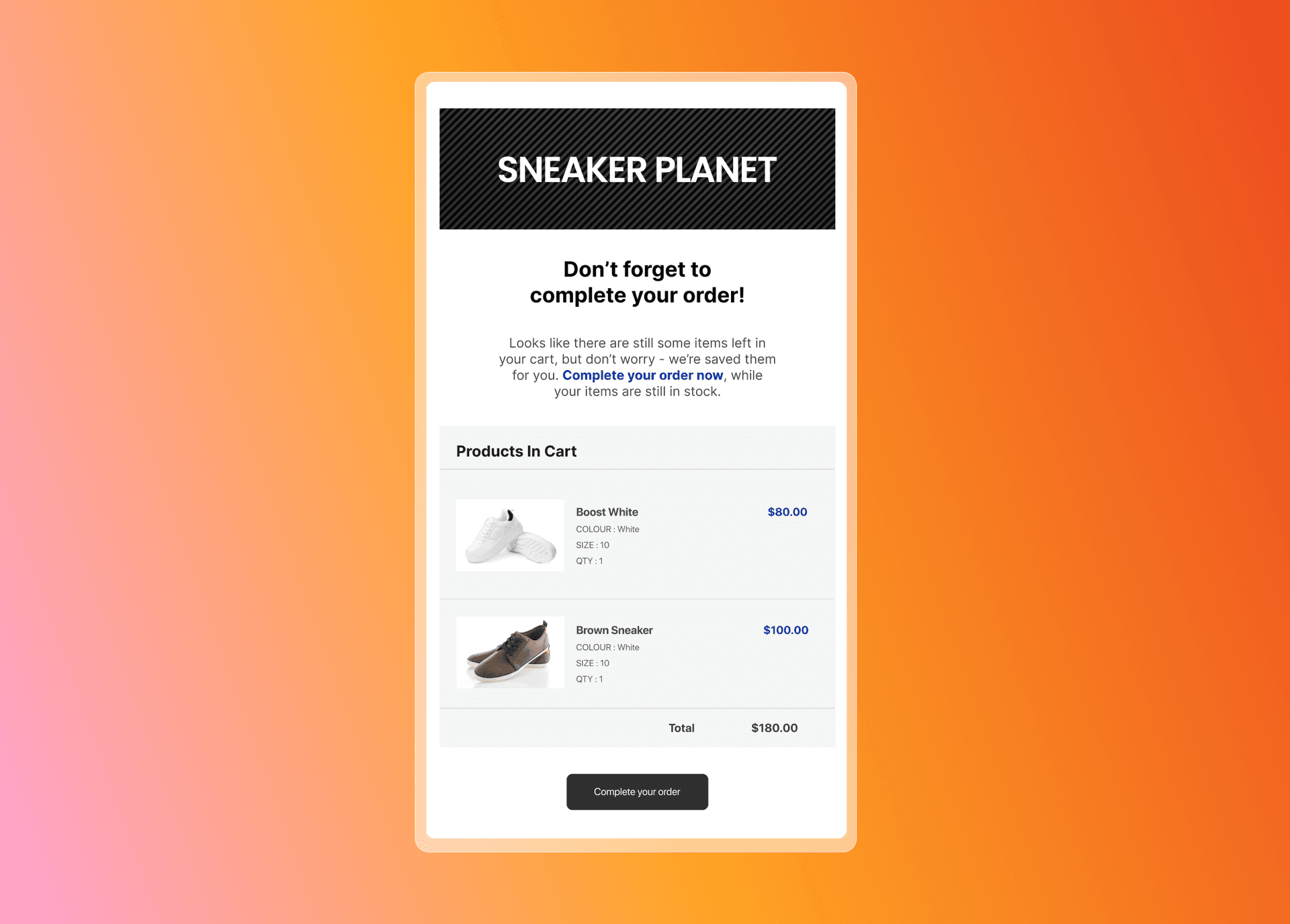
Running a cart abandonment email strategy
Shoppers who abandon a cart have already shown purchase intent, making them a warmer audience than cold prospects. Sequences are low-cost to set up, require no manual sending, and consistently outperform broadcast campaigns on conversion.
The limits of standard sequences
Rules-based cart recovery applies the same logic to every abandonment regardless of who the customer is or why they left, and this can be detrimental to both the customer relationship and the bottom line.
Why one-size-fits-all cart recovery leaves money behind
A generic abandoned cart recovery strategy may be easy to implement and increase revenue, but it also leaves money on the table because it's only doing half a job. The structural limits of rules-based recovery means that:
- Every abandoner receives the same sequence regardless of intent, purchase history, or channel preference. A disinterested, casual browser and a price-sensitive regular customer get identical follow-up.
- Blanket discount offers go out regardless of whether the customer needed one. A shopper who would have returned at full price within 24 hours still gets the 10% off, training buyers over time to abandon deliberately and wait for the incentive.
- Email-only recovery assumes every shopper checks their inbox promptly and acts on what they find. Many don't. Braze data shows brands using cross-channel customer engagement see 7.9X uplift in purchases per user compared to single-channel campaigns.
What AI decisioning does differently
AI decisioning replaces fixed if-then logic with a system that makes individual decisions for each customer and keeps updating those decisions based on what it learns. This is different from both rules-based automation and traditional next best action models.
eCommerce personalization strategy: From segments to individuals
Rules-based systems use predefined triggers.
Next best action models use machine learning to predict which product or offer a customer is most likely to respond to, but they still apply that recommendation at the segment level, optimize a single dimension at a time, and need manual retraining when behavior shifts.
AI decisioning goes a step further and uses reinforcement learning to optimize across every dimension simultaneously. Channel, message, creative, timing, frequency, offer depth, and whether to contact the customer at all, are continuously experimented with at the individual level, adapting regularly without human intervention. This is next best everything, and here’s a closer look at those elements.
Reinforcement learning-based action selection
Rather than following a predetermined path, a reinforcement learning agent selects from a range of possible actions, observes what happens, receives a signal when it hits the target, and updates its decision policy accordingly. Every interaction feeds back into the next decision. Over time, the system builds an increasingly accurate picture of what works for each customer.
Use case | Rules-based approach | AI decisioning approach |
|---|---|---|
Cart and browse abandonment follow-up | Every abandoner receives the same email sequence at fixed intervals, regardless of cart value, purchase history, or channel preference | The system selects channel, timing, message, and whether to include an incentive individually, based on each customer's behavior and likelihood to convert |
Discount and offer optimization | A discount is included in the sequence by default, applied to all abandoners at the same point in the flow | The system learns which customers convert without an incentive and withholds it accordingly, protecting margin without sacrificing conversion |
Repeat purchase and replenishment | A fixed follow-up email goes out a set number of days after purchase, based on average replenishment cycle across the customer base | The system learns each customer's individual purchase rhythm and selects the right moment, channel, and message to prompt the next order |
Individual-level decisions
The action selected for each person is the one most likely to move the KPI the system is optimizing for. Two customers with near-identical purchase histories might receive entirely different follow-ups because the system has learned they respond differently. At scale, this means every customer is effectively on their own journey, shaped by their own behavior rather than the average behavior of a group they happen to belong to.
Use case | Rules-based approach | AI decisioning approach |
|---|---|---|
Post-purchase cross-sell | The same cross-sell email goes to all recent purchasers, featuring the same products regardless of what was bought or who bought it | The system selects which product to feature, whether to include an offer, and when and how to reach out, based on each customer's purchase history and category affinity |
Loyalty tier progression | Customers move through tiers based on predefined spend thresholds, with the same communications at each stage | The system detects behavioral signals that indicate growing loyalty and adjusts engagement before a customer hits a formal threshold |
Seasonal campaign optimization | Campaign logic is manually reconfigured ahead of each seasonal period, based on last year's performance | The system adapts to shifting behavior patterns autonomously, updating its decisions as customer response to seasonal messaging changes in real time |
Continuous adaptation
As seasonal patterns shift, new product categories emerge, or previously effective incentives lose their pull, the system updates its own policies without anyone needing to rebuild the logic. It treats every interaction as new information rather than confirmation of what it already knows.
Use case | Rules-based approach | AI decisioning approach |
|---|---|---|
New product category adoption | A broadcast campaign goes to a broad segment, with targeting based on past category purchases | The system identifies which customers show early signals of interest in a new category and selects the right moment and message to encourage the first purchase |
Reactivation of lapsed customers | A win-back sequence fires after a set period of inactivity, with the same messaging and offer for all lapsed customers | The system experiments across message angle, channel, timing, and offer depth, learning what brings each individual back without over-incentivising |
Long-term retention | Customer retention eCommerce campaigns are triggered by churn risk scores crossing a predefined threshold, applying the same treatment to all at-risk customers | The system continuously monitors individual behavior and selects the most relevant engagement to maintain the relationship before risk indicators appear |
From abandoned cart recovery to customer loyalty: how decisioning extends beyond the abandoned cart moment
Cart recovery is one moment in a decisioning loop that runs across the entire customer lifecycle. The same AI decisioning system that selects the right follow-up for an abandoned cart can also determine the next best experience after a conversion, detect when a customer's behavior signals growing loyalty, and then use what it's learned to make abandonment less likely over time.
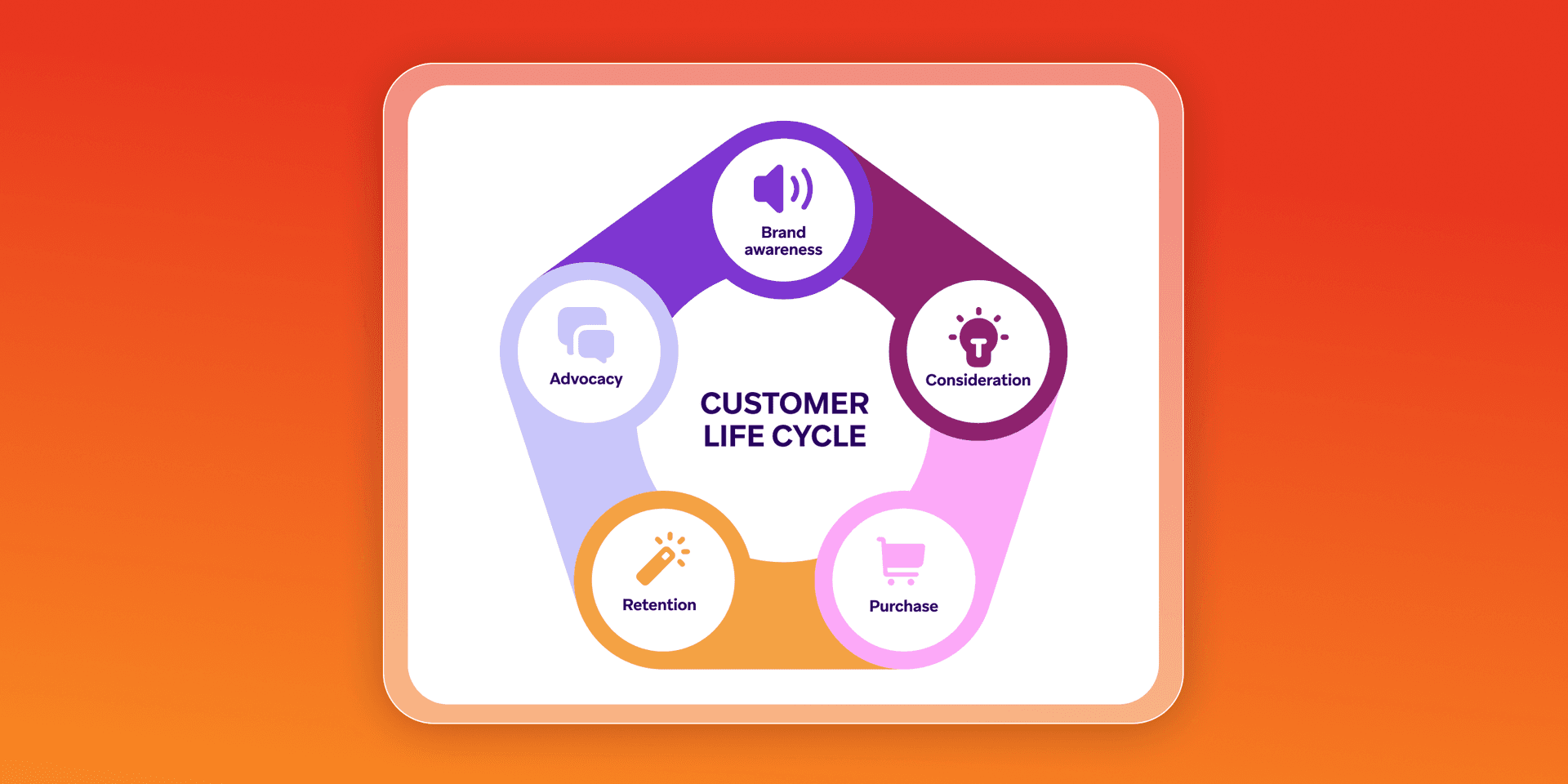
Post-purchase engagement
Conversion is where most cart recovery sequences stop. For an AI decisioning system, it's where the next decision begins. After a customer completes a purchase, the system works out what experience is most likely to bring them back. That could be a cross-sell, a replenishment prompt, a loyalty nudge, or nothing at all. Sending something to a customer who was already going to return doesn't strengthen the relationship. The system learns that too, and adjusts accordingly.
Loyalty signal detection
A shopper who moves from buying occasionally to buying regularly is signalling a shift. An engaged customer who suddenly disengages with your emails is signalling something different. Rules-based systems wait for a threshold to be crossed before changing how a customer is treated. AI decisioning picks up on behavioral shifts earlier and adapts its approach before the customer has formally signalled anything, and that's the difference between responding to loyalty and building it.
Preventing future abandonment
Every interaction a customer has with a brand generates data. Over time, an AI decisioning system builds an individual-level picture of each customer, including where they hesitate, what reassures them, and which channel brings them back. This shapes their engagement before friction appears. For example, a customer who has previously dropped off when shipping costs appear doesn't need to reach that point again before the system responds with something to improve their experience.
Retail customer engagement across the full lifecycle
Retail and eCommerce brands using AI decisioning move away from transactional thinking and start to see cart recovery as part of a bigger conversation, one that focuses on deepening the customer relationship over time. Not just recovering a lost sale, but making decisions that turn a one-time buyer into a repeat customer, recognise and reward growing loyalty, and keep a customer engaged before they drift away:
Repurchase optimization—the system learns the right moment, channel, and message to prompt each customer's next order based on their individual purchase rhythm, rather than a fixed post-purchase schedule.
Loyalty tier progression—behavioral signals that suggest customers are moving toward higher-value status are detected early, with engagement adjusted to reflect and accelerate that trajectory.
Long-term eCommerce customer retention—individual-level decisioning comes from accumulated data and keeps engagement relevant across the full customer lifecycle, so customers stay connected to the brand rather than drifting away between purchases.
Platforms that support AI decisioning for retail and eCommerce
Several AI decisioning platforms serve the retail and eCommerce space, though they approach AI decisioning from different directions and with different levels of sophistication. Some use reinforcement learning to make true 1:1 decisions across every campaign dimension simultaneously. Others offer AI-enhanced personalization and automation that improves on rules-based approaches, but don’t operate at the same level of individual optimization. Understanding the difference will help you to match the right tool to your business needs.
1. BrazeAI Decisioning Studio™
BrazeAI Decisioning Studio™ is a reinforcement learning-based decisioning layer integrated directly into the Braze Customer Engagement Platform. It optimizes across channel, message, creative, offer, timing, and frequency simultaneously for each individual customer, based on defined business goals and first-party data.
Decisioning capability: reinforcement learning agents experiment across every campaign dimension at once, learning from every interaction and updating decisions continuously without manual retraining.
Ideal for: omnichannel retail and eCommerce brands with high message volume, complex lifecycle programs, and a need to reduce blanket discounting while improving conversion and repeat purchase rates.
Key differentiator: native integration with Braze Canvas activates decisioning directly across email, push, SMS, and in-app channels without custom builds. BrazeAI Decisioning Studio sits within a broader ecosystem that includes BrazeAI™ Agents, the Braze Data Platform, and 140+ technology partner integrations, meaning decisioning can draw on unified customer data and connect to the tools retail teams are already using. Forward-deployed data scientists provide hands-on support for use case design, performance monitoring, and ongoing optimization.
2. Salesforce Marketing Cloud with Einstein Decisions
Salesforce Marketing Cloud includes Einstein Decisions as part of its broader Einstein AI capability set. The system evaluates each customer's profile and behavioral data to select the next best offer, promotion, or experience from a defined set, using a continuous-learning contextual bandit algorithm rather than static rules.
Decisioning capability: ML-driven next best offer selection based on customer context, behavioral data, and defined business value—removing the need to hard-code audience rules for every journey variant.
Ideal for: enterprise retailers already embedded in the Salesforce ecosystem, where Marketing Cloud, CRM, and commerce data are unified across the same infrastructure.
Key differentiator: tight integration with Salesforce's broader data and CRM layer means decisioning draws on a wide range of customer signals across sales, service, and commerce. Teams managing large product catalogs across multiple brand lines can connect promotional logic to commercial data without third-party pipelines.
3. Bloomreach
Bloomreach combines marketing automation, eCommerce search, and AI-powered personalization through its Loomi AI technology. Its engagement platform supports behavioral segmentation, product recommendations, and automated campaigns across email, SMS, web push, and mobile.
Decisioning capability: AI-driven personalization that adapts recommendations and messaging based on real-time behavioral data, with A/B testing and optimization built into the campaign workflow.
Ideal for: mid-market to enterprise eCommerce brands running high-SKU catalogs where search and recommendation quality directly affects conversion, particularly those looking to unify product discovery and customer engagement in a single platform.
Key differentiator: the combination of eCommerce search intelligence and engagement automation in one platform means personalization spans the full session, from how products are ranked in search results through to post-purchase follow-up.
4. Klaviyo
Klaviyo's AI capability, branded as K:AI, is built into its B2C CRM platform and covers predictive analytics, campaign automation, and personalization across email, SMS, mobile, and WhatsApp. Key features include channel affinity, which automatically identifies each customer's preferred channel and routes outreach accordingly, personalized send time optimization at the individual level, and AI-generated segments and flows.
Decisioning capability: predictive and generative AI that informs segmentation, flow logic, channel selection, and send timing. The Marketing Agent can autonomously build and launch campaigns based on customer data, with humans retaining oversight.
Ideal for: direct-to-consumer brands, particularly those running on Shopify or other major eCommerce platforms, where fast setup, strong channel coverage, and tight data integration are the priority.
Key differentiator: 350+ native integrations, including Shopify, WooCommerce, and BigCommerce, mean customer and order data flows into campaign logic with minimal configuration. Channel affinity adds a layer of individual-level routing that goes beyond standard segment-based approaches.
5. Attentive
Attentive is an AI marketing platform built primarily around SMS, MMS, RCS, email, and push, with AI products including AI Journeys and AI Pro. Its AI capabilities optimize audience targeting, message content, send timing, and channel delivery at the individual level, using two-way conversational messaging and generative AI trained on each brand's tone and voice.
Decisioning capability: AI that optimizes audience, content, timing, and destination of each message across SMS, email, push, and RCS. Two-way conversational messaging allows the system to respond to individual customer signals in real time rather than following a fixed sequence.
Ideal for: retail and eCommerce brands where SMS and mobile messaging are primary revenue channels, particularly those with high opt-in subscriber volumes looking to drive conversion through real-time, personalized interactions.
Key differentiator: depth of SMS and RCS specialization, including in-message shopping experiences where customers can browse, add to cart, and complete checkout without leaving the messaging app.
6. Hightouch AI Decisioning
Hightouch AI Decisioning is a warehouse-native decisioning platform that uses reinforcement learning to determine the best message, offer, channel, creative, timing, and frequency for each customer, including whether to contact them at all. It reads directly from cloud data warehouses such as Snowflake and Databricks, without storing customer data itself, and delivers decisions into existing marketing tools.
Decisioning capability: reinforcement learning agents that continuously experiment and adapt, optimizing 1:1 decisions across message, channel, offer, and timing. Agents have now made over 10 billion marketing decisions across production deployments in retail, QSR, fintech, and subscription.
Ideal for: data-mature enterprise retail teams whose customer data lives in a cloud data warehouse, and who want a decisioning layer that operates above their existing marketing stack rather than replacing it.
Key differentiator: warehouse-native architecture means decisioning draws on the most complete, up-to-date view of each customer without data replication. It connects to and activates through any downstream tool, including Braze, Salesforce, and Adobe, making it a composable addition to an existing stack rather than a platform replacement.
How to evaluate AI decisioning for your eCommerce stack
Choosing a decisioning platform is a different kind of decision than choosing a marketing automation tool. The questions aren't about features and channel coverage, they're about how the system makes decisions, what it can optimize for, and how much ongoing work it requires from your team.
Does the system use reinforcement learning or rules-based logic?
A rules-based system, even one enhanced with ML-powered predictive scoring, applies predetermined messaging to predetermined segments. A reinforcement learning system experiments across options, observes outcomes, and updates its decision policy autonomously. One requires human judgment to improve, the other learns without it. When talking to vendors, ask:
- How does the system update its decisions after deployment?
- Does that process require manual intervention?
Can it make individual-level decisions rather than segment-level recommendations?
For retail and eCommerce, purchase patterns, price sensitivity, and channel preferences vary significantly even within tight segments. Applying the same experience to everyone in a group costs you on conversion and on margins. Two customers with near-identical profiles might need completely different messaging. Questions to ask:
- How many unique decision combinations can the system generate?
- Can two customers in the same segment receive meaningfully different experiences?
How does it integrate with purchase history, browse behavior, and loyalty data?
The most valuable signals for retail decisioning are purchase recency and frequency, category affinity, browse behavior, loyalty status, and incentive response history. Platforms that require data to pass through multiple systems before reaching the decisioning layer introduce latency that reduces the relevance of every decision. Things to confirm with platforms:
- Does it connect directly to your existing data infrastructure, whether that's a CDP, a cloud data warehouse, or a platform like Shopify?
- How quickly do behavioral signals translate into updated decisions?
What KPIs can it optimize against?
A full eCommerce lifecycle orchestration calls for the tracking of a different set of success metrics. Abandoned cart follow-up might optimize for conversion rate, revenue per customer, or average order value. Post-purchase engagement might target repeat purchase rate. Loyalty programs might focus on customer lifetime value. A capable decisioning system should be able to optimize against any of these, not just engagement proxies like opens and clicks. Check with vendors:
- How is the success metric configured for different use cases?
- Can the system optimize for profit per customer rather than volume alone?
Does it adapt autonomously or require manual retraining?
Customer behavior in retail shifts constantly, driven by seasonality, new product launches, promotional history, and broader market conditions. A system that requires data scientists to retrain models each time behavior patterns shift, creates a lag between what customers are doing and what the decisioning system knows. You’ll need to clarify:
- How does the system handle behavioral drift?
- What triggers a policy update, and does your team need to be involved?
These questions give a reliable picture of whether a platform is genuinely doing AI decisioning or applying a more sophisticated version of the segment-and-rule approach it's meant to replace.
FAQs for abandoned cart emails
What are abandoned cart emails and do they still work?
Abandoned cart emails are automated messages sent to shoppers who add items to an online cart but leave without completing their purchase. They consistently outperform broadcast campaigns on conversion and remain a widely used recovery tactic, though their effectiveness depends on timing, relevance, and whether they sit within a broader cross-channel strategy.
How does AI decisioning improve abandoned cart recovery?
AI decisioning improves abandoned cart recovery by replacing fixed sequences with individual-level decisions. Rather than sending every abandoner the same emails at the same intervals, the system selects the right channel, message, timing, and whether to include an incentive for each customer, based on their behavioral history and the outcome the system is optimizing for.
What is the difference between cart abandonment automation and AI decisioning?
Cart abandonment automation follows predefined rules—if a cart is abandoned, send this sequence. AI decisioning experiments across every variable simultaneously, including channel, message, creative, timing, and offer depth, and updates its decisions based on what it observes for each individual. Automation executes a fixed path. AI decisioning continuously learns which path works for each person.
How does AI decisioning help build customer loyalty in eCommerce?
AI decisioning helps build customer loyalty by treating the customer relationship as an ongoing series of individual decisions rather than a sequence of campaigns. After conversion, the system selects the most relevant next experience for each customer, detects behavioral signals that indicate growing loyalty, and uses accumulated data to make engagement more relevant over time.
What channels do brands use for cross-channel cart recovery?
Most retail and eCommerce brands combine email, push notifications, SMS, and in-app messaging for cart recovery. Email remains the most widely used, but push and SMS often drive faster re-engagement for mobile-first audiences. The strongest approaches use behavioral signals to determine which channel to lead with for each individual customer rather than defaulting to the same channel for everyone.
Related Tags
Be Absolutely Engaging.™
Sign up for regular updates from Braze.