AI personalized content: How to deliver the right message to every customer at scale
Published on July 16, 2026/Last edited on July 16, 2026/8 min read
Team Braze
Contents
AI personalized content uses AI to create the message each customer receives and to select which version they see. The creation side generates the variants, the subject lines, copy, images, and offers. The selection side uses decisioning to match the right variant to each person.
True 1:1 content is hard, if not impossible, to do manually. It needs more creative and more decisions than a team can produce at the scale of a full customer base.
AI splits the work into two jobs. The first builds a library of on-brand content variants at scale. The second uses decisioning to choose the right variant for each individual, then learns from how they respond.
Here's how both jobs work, how they run across your channels, and what they look like in practice.
TL;DR
- AI personalized content does two jobs: it generates a library of on-brand variants (subject lines, copy, images, offers) and selects which version each individual customer receives.
- Generation produces a finite set of approved variants from a single concept, not a unique piece of creative written from scratch for every person.
- Selection runs on a decisioning layer using contextual bandits and reinforcement learning, which learns from each customer's behavior and updates its choice over time.
- The same generate-and-select logic runs across email, push, SMS, in-app, and web, with dynamic content adapting each message to the channel and one customer profile keeping it consistent.
- Brands including Pazza Pasta, Kayo Sports, Coches, and Luxury Escapes use this approach, with Braze combining Creative Studio, BrazeAI Decisioning Studio™, and cross-channel messaging on shared first-party data.
What is AI personalized content?
AI personalized content is content created and chosen by AI so each customer receives the specific message most likely to work for them. AI generates the variants, then a decisioning layer picks which one each person sees.
In comparison, rules-based personalization applies an instruction the marketer sets in advance, inserting a first name, swapping the hero image for a lapsed segment, or sending version A to one list and version B to another. Most businesses are familiar with this type of personalization, but AI achieves personalization at scale that a rules-based strategy could never manage, by choosing the right content per person rather than per segment.
AI content personalization needs a content library, which gives the system a set of on-brand variants to choose from. It also needs a decisioning layer to assign the right variant to each customer and update that choice as they engage. There are wider AI marketing personalization decisions that can be made too.
How AI generates personalized content for marketing
AI generates personalized content by producing a set of on-brand variants from a single concept. Brief the model once and it hands back many usable versions, different subject lines, body copy, images, and product blocks.
One concept can also give localized variants and options with different tones.
What this creates is a content library, with a finite set of approved content variants, not a unique piece of creative written from scratch for every individual.
Using enterprise generative AI for content turns one good idea into dozens of on-brand options a marketing team can actually use.
How AI selects the right content for each customer
AI selects content with a decisioning layer. AI decisioning uses contextual bandits (algorithms that pick the best option based on context) and reinforcement learning (learning through trial-and-error feedback) to choose from the available variants and match them to each individual.
The engagement and behavior of each recipient is observed and then fed back into the decisioning layer. That way it can continuously learn and optimize, evolving with each new interaction and choosing the most relevant content for a customer at any given moment.
This learning loop separates fixed rules from individual-level decisioning. It turns a content library into genuine 1:1 personalization, without authoring unique content per person.
AI content personalization across channels
AI content generation marketing works the same way across email, push, SMS, in-app messages, and web, to personalize the experience. It adapts to each channel's constraints automatically, such as length, format, or preview.
AI dynamic content
AI dynamic content keeps each message current at the moment it reaches someone. Dynamic content pulls live data into the message at send time, so what a customer sees reflects their latest behavior, not a version assembled days earlier.
The consistency across every channel is achieved through one customer profile and one decisioning layer feeding every channel, so that each person receives the message matched to them, wherever, however and whenever they are reached.
AI personalized content marketing use cases
Here are four brands putting generation and selection to work across recommendations, lifecycle messaging, winback, and onboarding.
Use case | Company | AI personalized content | Channels | Results |
|---|---|---|---|---|
Product and offer recommendations selected per customer | Circus Group's Pazza Pasta | Live Catalog of dishes assembled per person in Canvas; beta use of AI Item Recommendations and Personalized Paths | WhatsApp, email | 6X higher purchase rates and 4.5X higher conversion rates for products added, vs. email |
Lifecycle messaging matched to stage and behavior | Kayo Sports | BrazeAI Decisioning Studio™ selects message, creative, channel, timing, and frequency per subscriber; 300 to 1.2 million variations | Email, SMS, push, in-app | 14% increase in subscriptions in FY24; 105% increase in cross-sells |
Winback and retention content chosen by decisioning | Coches | Intelligent Channel picks each lapsed user's best channel; Canvas Flow personalizes by last activity | Email, push | 2892% increase in monthly reactivated users; 2400% increase in conversions (push and email together) |
Onboarding adapted to early behavior | Luxury Escapes | BrazeAI Agent Console™ weighs 10 website signals to assign each new user to the right welcome cohort | 10% increase in revenue per user; 7% increase in total transaction value |
Product and offer recommendations selected per customer
Circus Group's Pazza Pasta, a delivery-first pasta brand in Germany, moved its weekly menu off a single email blast and onto messages built around each customer's tastes.
AI personalized content: A Braze Catalog holds the live dish data, kept current through a Google Sheet synced from Snowflake, and the weekly menu is assembled in Canvas so each person sees relevant dishes. The team also beta-tested AI Item Recommendations to suggest dishes per customer and Personalized Paths to match each person with the message they're most likely to open.
Channels used: WhatsApp and email.
Results: Against the same campaign sent by email, WhatsApp drove 6X higher purchase rates and 4.5X higher conversion rates for products added.
Lifecycle messaging matched to stage and behavior
Kayo Sports, Australia's largest sports streaming service, wanted to give a diverse base of fans genuinely individual communications rather than generic sends across TV, mobile, and web.
AI personalized content: Its "Customer Cortex" runs on BrazeAI Decisioning Studio™, which selects the message, creative, channel, timing, frequency, and promotion for each subscriber. Powered by reinforcement learning-based action selection and ten purpose-built models, the setup expanded the number of possible communication variations from 300 to 1.2 million, each matched to an individual.
Channels used: Email, SMS, push notifications, and in-app messages.
Results: The approach drove a 14% increase in subscriptions in FY24 and a 105% increase in cross-sells, while average subscription prices rose 20%.
Winback and retention content chosen by decisioning
Coches, Spain's online automobile marketplace for buyers and sellers, wanted to bring lapsed users back rather than sending every inactive user the same reminder.
AI personalized content: Braze Intelligent Channel sorts each lapsed user by the channel they engage with most, and Canvas Flow personalizes the follow-up by their last activity, so a returning buyer sees cars they recently viewed rather than a generic nudge.
Channels used: Email and push, chosen per user by most-engaged channel.
Results: The reactivation program saw a 2892% increase in monthly reactivated users, and a 2400% increase in conversions for users reached on both push and email.
Onboarding adapted to early behavior
Luxury Escapes, a fast-growing travel company with more than 9 million members, wanted its welcome journey to read each new user more precisely than fixed session-count rules allowed.
AI personalized content: BrazeAI Agent Console™ works as the decisioning layer, weighing ten distinct website signals to assign each new user to the right welcome cohort, which determines the content they receive. The agent needs no training data, so it can make a nuanced call three days after signup, before any purchase history exists.
Channels used: Email.
Results: Against a rules-based control, the agent-based approach delivered a 10% increase in revenue per user and a 7% increase in total transaction value.
How Braze powers AI personalized content
Braze brings content generation, AI decisioning, and cross-channel delivery together on one platform, all drawing on the same first-party data. Marketers create the variants, let AI choose what each person receives, and deliver it wherever a customer is active, without stitching together separate tools.
That connection between the data and the AI is where the personalization engine comes from. Each capability reads from the same customer information, so the content a team builds and the choices made about it stay in step.
- Creative Studio builds and manages the content library. Teams sync designs from Figma and Canva, reuse content blocks across channels, and run AI-generated copy against built-in brand guidelines, giving the decisioning layer a set of on-brand options to choose from.
- BrazeAI Decisioning Studio™ handles selection per individual. Built on reinforcement learning-based action selection, its agents optimize channel, message, creative, offer, timing, and frequency at once for each customer, and track uplift against a control group so the impact is measurable.
- Cross-channel messaging keeps the experience consistent from one channel to the next. Dynamic content embeds live products, recommendations, and promotions into messages across email, SMS, mobile, web, and more, all working from the same customer view.
Bringing generation, decisioning, and delivery onto shared data is what lets a team personalize for millions of individuals without writing a message for each one.
AI personalized content FAQs
What is AI personalized content?
AI personalized content is content created and chosen by AI so each customer receives the message most likely to work for them. AI generates the variants, the subject lines, copy, images, and offers, and a decisioning layer selects which version each individual sees based on their behavior.
How does AI create personalized content at scale?
AI creates personalized content at scale by generating a finite library of on-brand variants, then using decisioning to match the right one to each person. Rather than authoring a unique message per customer, it produces a set of options and selects among them individually, so millions of people can receive relevant content.
What is the difference between generating content and personalizing it?
Generating content and personalizing it are two separate jobs. Generating content means producing the variants, the copy, images, and offers a campaign can use. Personalizing it means selecting which of those variants each customer sees. Generation gives you the options, and selection decides who gets which one.
How does AI choose which content each customer sees?
AI chooses which content each customer sees with a decisioning layer built on contextual bandits and reinforcement learning. It reads what it knows about a person, picks the variant most likely to earn a response, then learns from how they react and adjusts its choice as their behavior changes.
Can AI personalize content across channels?
Yes, AI can personalize content across channels. The same generation and selection logic runs across email, push, SMS, in-app messages, and web, drawing on one customer profile. Dynamic content adapts each variant to the channel's format automatically, so a person receives a consistent, relevant message wherever they are reached.
Related Tags
Be Absolutely Engaging.™
Sign up for regular updates from Braze.
Related Content
 Article8 min read
Closing deals, driving growth for customers, and the team behind it: Life as an Account Executive at Braze
July 17, 2026 Article12 min read
BrazeAI™ marketing tools: The complete guide to AI-powered customer engagement
July 17, 2026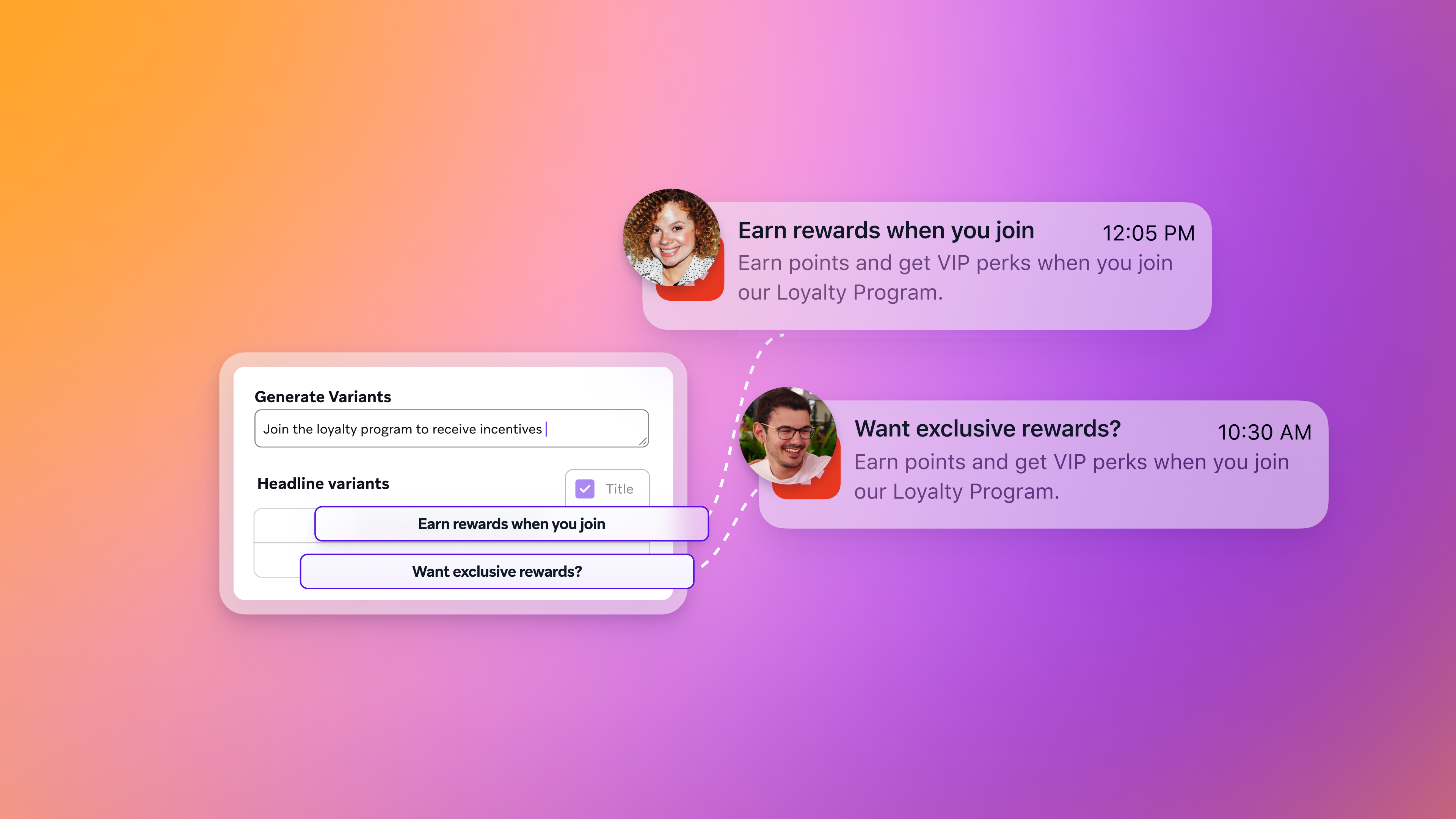 Article12 min read
AI email marketing: How to use AI to run smarter email programs
July 16, 2026