What is customer engagement? A complete guide for 2026
Published on March 25, 2026/Last edited on March 25, 2026/14 min read

Madison Tiemtoré
Content Marketing Lead, BrazeContents
Customer engagement is the ongoing relationship between a brand and its customers—built through every interaction, message, and experience across the entire customer lifecycle. It's not a campaign metric. It's a measure of how well a brand is showing up for its customers over time.
In an environment where customers interact with brands across dozens of touchpoints and expect every one of those moments to feel relevant, engagement has shifted from something brands trigger to something they sustain.
This guide covers how the fastest-growing brands are making that happen—and how to build the same kind of continuous, intelligent engagement for your own customers.
TL;DR: Customer engagement
- Customer engagement is the ongoing relationship between a brand and its customers across the lifecycle. Strong engagement uses behavioral data, personalization, cross-channel messaging, and AI decisioning to drive retention, loyalty, and lifetime value.
Key takeaways:
- Effective customer engagement strategies go beyond scheduled campaigns by continuously adapting messaging, timing, and channels based on individual customer behavior and intent, enabling brands to meet customers where they are and deliver relevant experiences that build trust over time.
- Measuring engagement requires tracking multiple metrics—such as retention rate, monthly active users, customer lifetime value, and conversion rates—over time to understand how deeply customers connect with a brand and to identify opportunities for ongoing optimization and growth.
What is customer engagement?
Customer engagement is the ongoing practice of building and maintaining meaningful relationships between a brand and its customers. It encompasses every interaction across the customer lifecycle—not just individual campaigns or one-off messages, but the cumulative experience a customer has with a brand over time.
A single interaction doesn't make for strong engagement. What matters is whether customers feel seen, understood, and communicated with in ways that are relevant to where they are and what they need. Brands that get this right build something that compounds over time—each relevant interaction reinforcing trust, and trust making the next interaction more likely.
Strong customer engagement marketing connects directly to the outcomes brands care most about. Customers who are actively engaged are more likely to stay loyal, make repeat purchases, and advocate for a brand—making engagement one of the clearest drivers of retention, lifetime value, and long-term growth.
The brands that do this most effectively think of engagement not as a series of messages, but as a continuous series of decisions, constantly asking what the most relevant action is for each customer, right now.
What | Campaign / use case | New customer onboarding flow |
|---|---|---|
Where | Channel | |
When | Scheduled / triggered / API | Triggered upon session start |
Who | Target audience | New users |
Why | Conversion event | User makes an account or makes a purchase |
Why is customer engagement important?
Customer engagement is important because expectations have fundamentally shifted. People expect brands to know what they want, when they want it, and to reach them in ways that feel personal rather than broadcast. When that relevance is missing—when messages feel generic, or timing feels off—customers don't complain. They simply disengage.
The financial impact of poor customer engagement is well documented. According to the Braze What is Customer Engagement guide, 39% of brands that missed their revenue goals were using disconnected point solutions—fragmented technology that makes it almost impossible to build a consistent, accurate picture of the customer.
When brands can't see their customers clearly, they can't engage them effectively, and churn becomes an inevitable outcome.
The inverse is equally compelling. The Braze Customer Engagement Index—a framework that tracks engagement maturity across data usage, AI utilization, and messaging sophistication—classifies the highest-performing brands as "Ace" brands: those that have embraced customer-centric, data-informed approaches to engagement.
According to the 2026 Global Customer Engagement Review, 70% of Ace brands didn't just hit their revenue goals in 2025—they exceeded them.
A customer who feels understood stays longer, spends more, and costs significantly less to retain than a new one costs to acquire.
What is a customer engagement strategy?
A customer engagement strategy is a structured approach to how a brand builds and maintains relationships with its customers across their entire lifecycle. It defines not just what to communicate, but when, where, and why—aligning data, messaging, timing, and channels around the needs of individual customers rather than the convenience of batch campaigns. Critically, a strategy connects those decisions to business goals—whether that's increasing customer lifetime value, improving retention rates, growing market share, or driving revenue per customer.
Many brands have a messaging plan—a schedule of what to send and when. A customer engagement strategy goes further, connecting every communication decision to a broader understanding of where the customer is in their relationship with the brand, and what would be most valuable to them at that moment. This is the foundation of effective lifecycle marketing—meeting customers where they are, not where a campaign schedule assumes them to be.
Real-time decisioning is what separates a modern engagement strategy from a static one. Fixed rules and pre-built journeys can't adapt to the way individual customers actually behave. The most effective strategies are built around a continuous series of decisions, constantly asking what the most relevant action is for each customer, right now.
Understanding how different customer engagement models operate can help brands identify the right strategic framework for their audience and goals.
Key components of an effective customer engagement strategy
A strong customer engagement strategy is the product of several interconnected disciplines working together. The brands that consistently engage well tend to share the same foundations, and understanding each one helps clarify where gaps in your own approach might be costing you.
Understanding customer behavior and intent
First-party and behavioral data are the starting point for any meaningful engagement. Knowing what customers do—which features they use, what they browse, when they disengage—gives brands the context to communicate with purpose rather than assumption. Without that behavioral foundation, even the most sophisticated channel strategy will miss the mark.
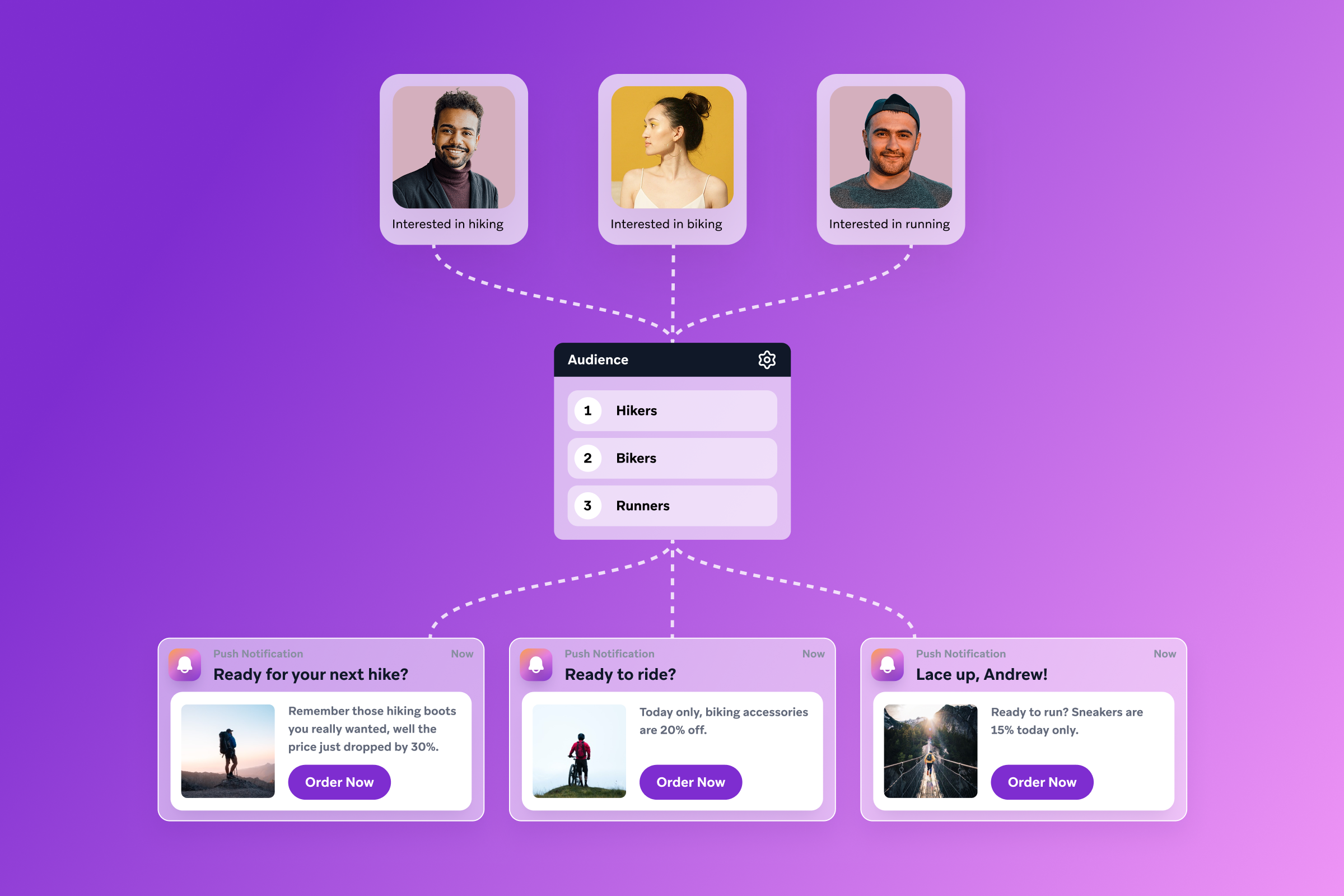
Personalization at scale
Effective personalization uses first-party data to tailor content, timing, and channel to the individual—dynamically, and at scale. Customers who receive messages that feel genuinely relevant to them are more likely to engage, convert, and stay. Inserting a first name into a subject line is a long way from what personalization looks like now—today it means assembling the right message, for the right person, at the moment it will land best.
Real-time relevance
Timing is as important as content. A message that would have been compelling yesterday can feel intrusive or irrelevant today. Brands that can act on behavioral signals in real time consistently outperform those working from static schedules and fixed send times. Real-time engagement is what keeps a brand feeling relevant rather than reactive.
Cross-channel consistency
Customers move between channels without thinking about it. They might open an email on their laptop, respond to a push notification on their phone, and complete a purchase in-app—all within the same hour. A coherent engagement strategy reflects that reality, delivering a consistent experience regardless of where or how the interaction happens.
Measurement and continuous optimization
The brands that improve fastest treat every campaign as a source of learning—testing messaging, timing, and channel mix, then using those findings to sharpen what comes next. Tracking engagement metrics over time, rather than campaign by campaign, reveals patterns in customer behavior that individual results alone won't show. Those patterns are what allow strategy to evolve rather than stagnate.
Customer engagement marketing across the lifecycle
Customer engagement marketing doesn't look the same at every stage of the relationship. What a new customer needs from a brand is fundamentally different from what a loyal one does—and the brands that recognize this, and adapt their approach accordingly, build relationships that last significantly longer and deliver significantly more value.
Onboarding and activation
The earliest interactions set the tone for everything that follows. Onboarding is the moment a brand has the most attention and the least trust—which means the priority is demonstrating value quickly and clearly, not overwhelming new customers with features or offers they aren't ready for. A well-designed onboarding experience reduces friction, builds confidence, and gives customers a reason to come back before the novelty wears off.
Ongoing engagement and value reinforcement
Once a customer is active, the challenge shifts from getting their attention to keeping it. Ongoing engagement is less about acquisition mechanics and more about consistently reinforcing why the relationship is worth maintaining—through relevant recommendations, timely updates, and communications that reflect what the brand knows about that individual. Customers who feel regularly seen and catered to are far less likely to drift toward a competitor.
Retention and re-engagement
Every customer base includes people who are starting to disengage—visiting less frequently, ignoring messages, or showing early signs of churn. Identifying those signals early, and responding with targeted, relevant outreach, gives brands a meaningful window to re-establish value before a customer leaves entirely. Retention campaigns built on behavioral signals consistently outperform those built on time-based rules alone.
Long-term loyalty and relationship building
The most valuable customer relationships are the ones that have moved beyond transactional. They have created a customer experience that people want to return to. Long-term customers who feel genuinely connected to a brand don't just spend more—they advocate, refer, and forgive occasional missteps in ways that newer customers won't. Sustaining that depth of relationship requires consistency over time—continuing to personalize, continuing to listen, and continuing to find ways to add value as both the customer and the brand evolve.
Customer engagement examples
The principles of strong customer engagement are one thing—seeing them in action is another. Here's how three very different brands approached engagement, and what they achieved.
Too Good To Go serves up a 135% increase in purchases with personalization that hits the spot
Too Good To Go connects consumers with unsold surplus food from restaurants and grocery stores through discounted "Surprise Bags," with a mission to reduce food waste globally.
The challenge
High app traffic wasn't translating into purchases. Surprise Bags are limited in supply and only relevant to nearby users, so generic messaging was creating frustration rather than conversions.
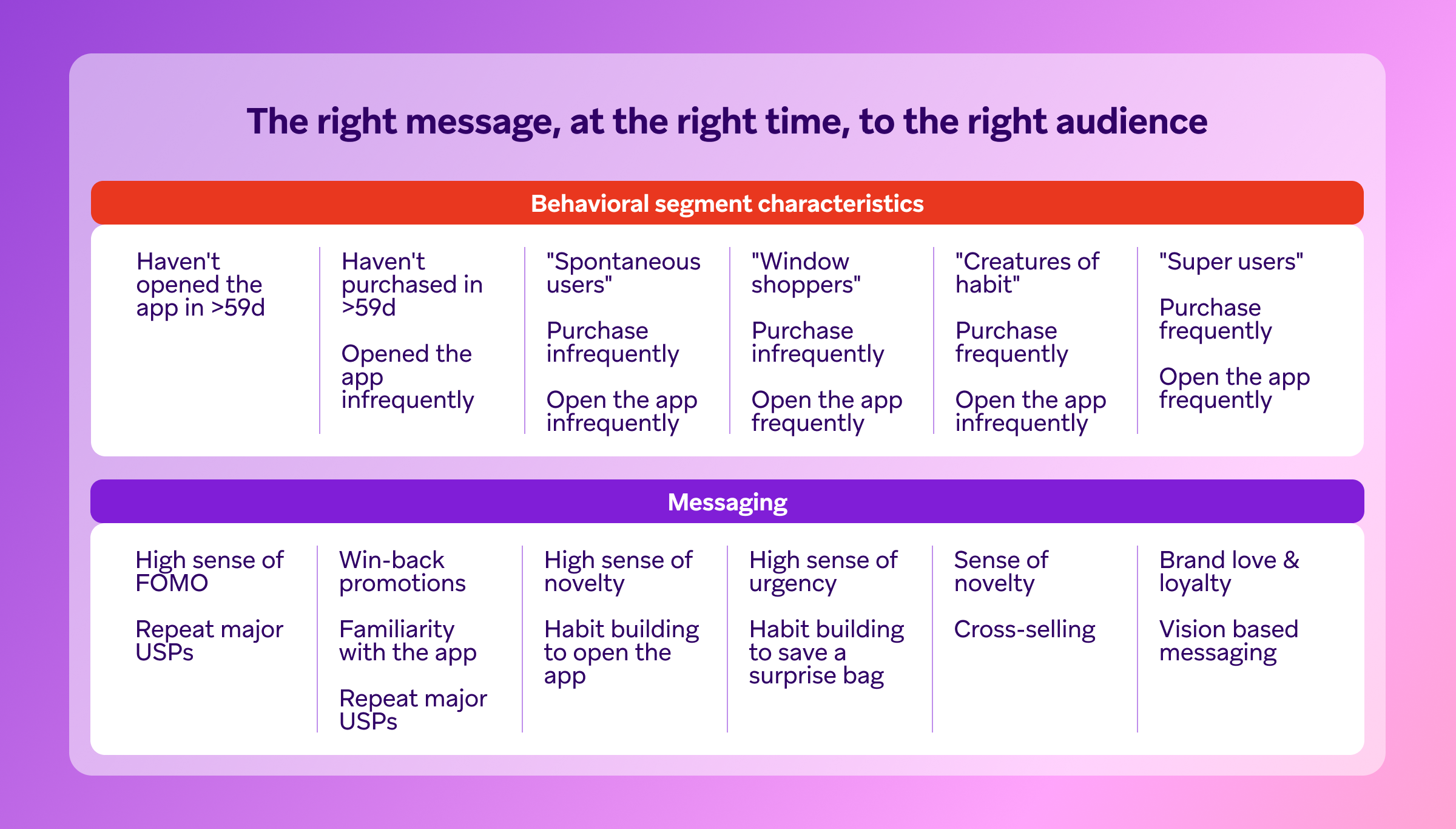
The strategy
Using behavioral segmentation and real-time supply data, Too Good To Go built API-triggered campaigns that matched the right user with the right Bag, in the right location, at the right moment. When engagement scores dropped, automated re-engagement campaigns kicked in, personalized to each user's location and preferences.
The wins
- 135% increase in purchases attributed to CRM
- 2x increase in message conversion rate
- Behavioral sync ran automatically once established, freeing the team to focus on strategy
Second Dinner plays its cards right for 96% player awareness
Second Dinner is the independent studio behind MARVEL SNAP, a fast-paced collectible card game. Sustaining player engagement long after launch is one of gaming's hardest challenges.
The challenge
After the launch buzz faded, Second Dinner needed to keep MARVEL SNAP feeling fresh without disrupting gameplay or overwhelming their development team with content updates.
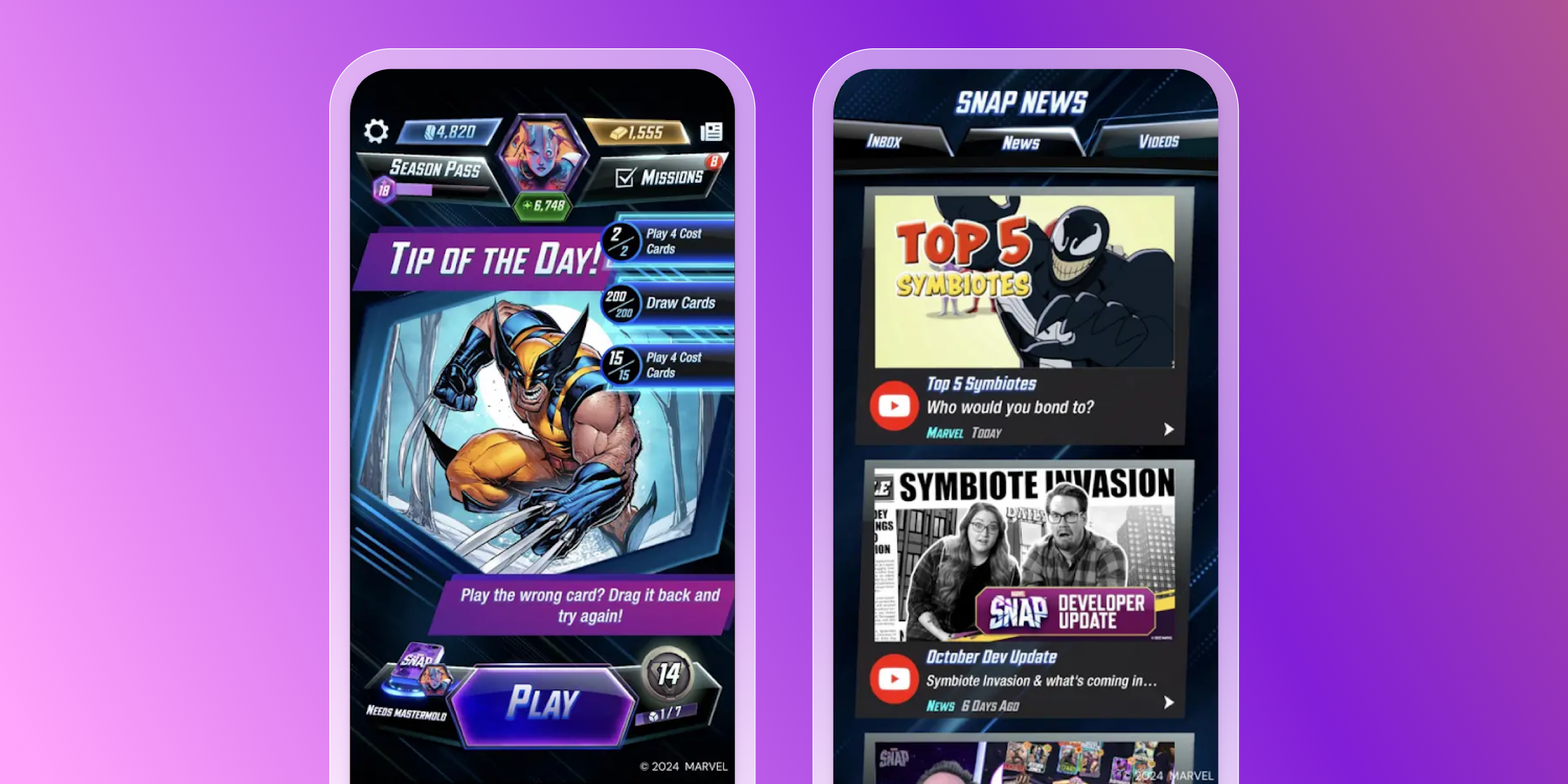
The strategy
Content Cards—persistent, personalized messages embedded directly in the app—delivered game news, fan spotlights, and event updates without interrupting play. Journeys adapted in real time to player behavior, and content could be updated without a full app release.
The wins
- 96% of players identified Content Cards as their first point of awareness for new campaigns
- 86% of traffic to the campaign's voting page was driven by Content Cards
- Production timelines cut significantly, enabling faster response to player insights
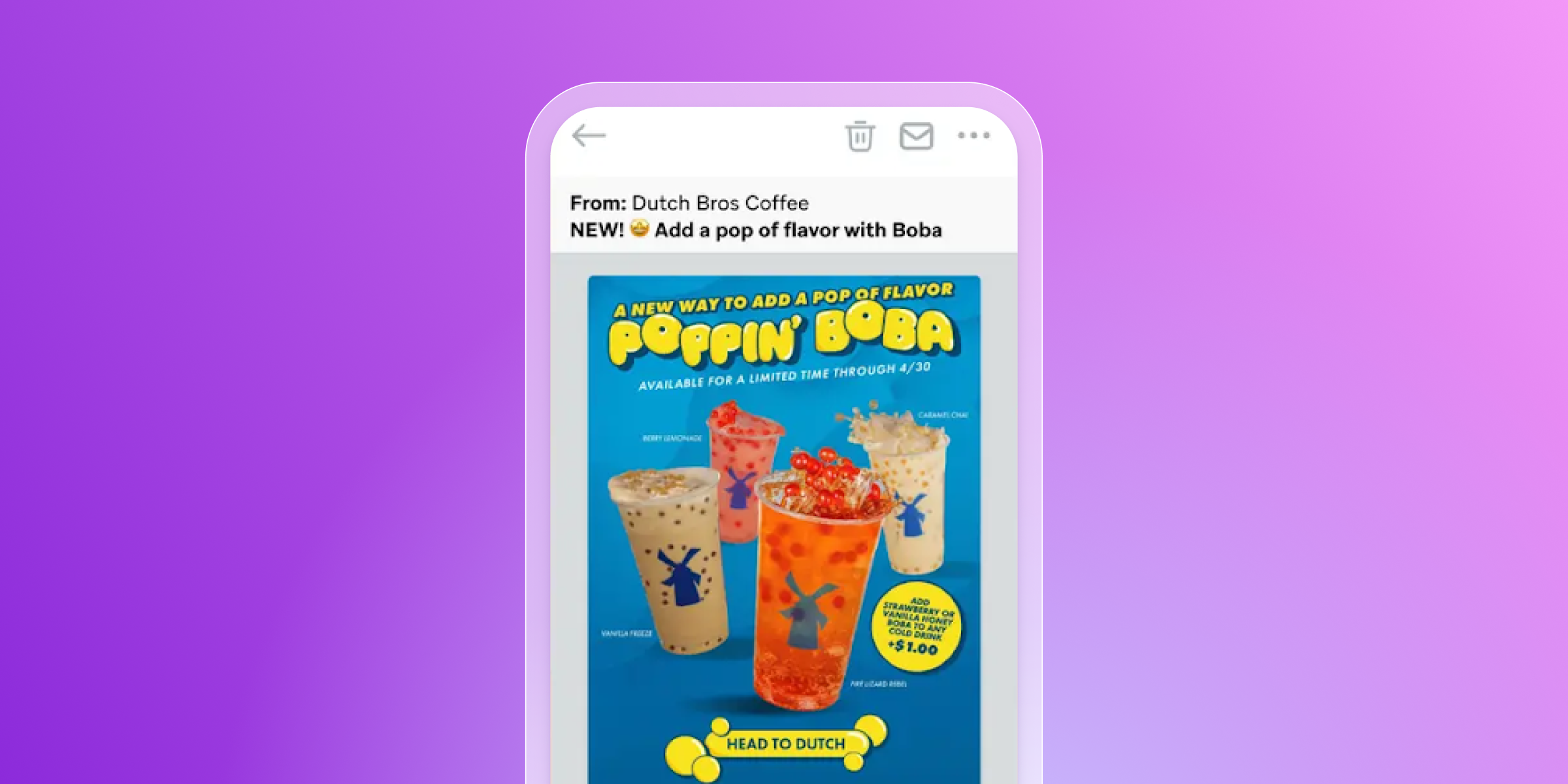
Dutch Bros brews up a 230% ROI increase with cross-channel engagement
Dutch Bros is a US beverage brand with more than 800 locations. It defines itself as being in the "relationship business"—and its app is built to extend that relationship digitally, not just facilitate transactions.
The challenge
Fragmented technology was producing inconsistent experiences across channels, increasing costs, and preventing Dutch Bros from delivering the 1:1 connection central to its brand.
The strategy
Dutch Bros built a unified cross-channel strategy across email, SMS, push, and in-app messaging, with personalization driven by purchase history, location, and individual preferences. Journey orchestration kept every channel coordinated, and dynamic content pulled in location-specific product recommendations for each customer.
The wins
- 230% increase in ROI from CRM campaigns
- 31% cost savings from platform consolidation
- Faster campaign decision-making and the ability to iterate on messaging in real time
How AI is changing customer engagement
For years, engagement strategies relied on rules—if a customer does X, send Y. Those rules were a significant step forward from batch-and-blast sending, but they have a hard ceiling. They can't account for the full complexity of individual customer behavior, and they require constant manual maintenance to stay relevant as audiences and conditions change.
AI-powered engagement systems work differently. Rather than following fixed paths, they analyze behavioral signals continuously—learning from what customers do, predicting what they're likely to do next, and determining the most relevant action to take at any given moment. Engagement adapts in real time, without requiring a marketer to manually rebuild a journey every time conditions change.
Predictive capabilities are particularly valuable for retention. AI-powered solutions give brands the opportunity to act before churn becomes a certainty—identifying customers who are showing early signs of disengagement and responding with messaging calibrated to the individual rather than broadcast to a particular audience segment.
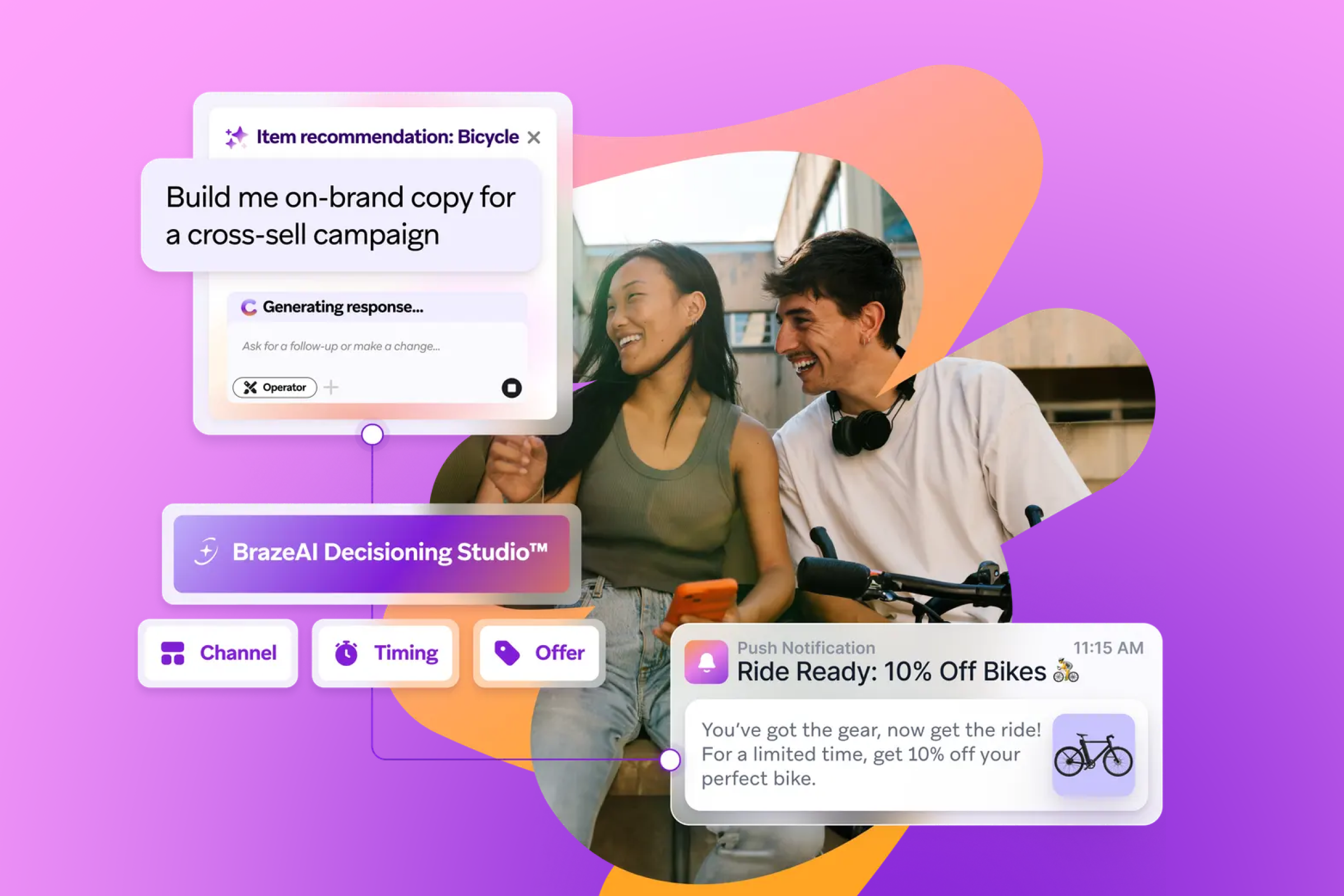
AI decisioning takes this further still, supporting a customer experience that is truly 1:1. Rather than a marketer choosing between options for a given audience, an AI decisioning system, like BrazeAI Decisioning Studio™, can evaluate each customer individually and makes "next best everything" decisions—simultaneously optimizing across message, channel, offer, creative, timing, and frequency for each person, all at once.
This is fundamentally different from selecting a single next best action. Marketers define the goal and the guardrails; the AI handles the continuous experimentation and learning at a scale no rules-based system can match.
Customer engagement metrics: How to measure customer engagement
Measuring customer engagement means resisting the pull of individual campaign performance. A single open rate or click-through tells you something, but it doesn't tell you whether a customer is genuinely engaged with your brand over time. The most useful measurement approach tracks behavioral signals across the lifecycle, building a picture of how the relationship between a customer and your brand is evolving.
These are the core customer engagement metrics you can use to assess engagement:
Retention rate: Measuring the percentage of customers who keep coming back
A high retention rate signals that your engagement efforts are working—customers are finding enough value to keep coming back. Tracking retention alongside churn rate reveals where customers are dropping off and at what stage of the lifecycle, which is where your optimization efforts tend to have the greatest impact.
Monthly active users (MAU): Tracking how frequently customers engage
MAU counts the number of individual users who engage with an app or product within a given month, with each person counted once regardless of how many times they interact. Tracking MAU alongside daily active users (DAU) gives a more granular view of engagement patterns—the DAU/MAU ratio in particular is a useful indicator of how frequently your customers are returning, often referred to as stickiness.
Customer lifetime value (CLV): Connecting engagement to commercial outcome
CLV represents the total revenue you can expect from a customer over the full duration of their relationship with your brand. It's one of the most meaningful engagement metrics because it ties engagement directly to commercial outcome—customers who are actively and consistently engaged tend to have significantly higher lifetime values than those who interact sporadically.
Conversion rate: Measuring how effectively engagement drives action
Conversion rate measures how effectively your engagement efforts drive customers to take a desired action—whether that's making a purchase, completing a profile, or redeeming an offer. Tracking conversions across different channels reveals where customers are most likely to act, which informs both your channel strategy and messaging decisions.
Click-to-open rate (CTOR): Gauging content relevance for email programs
For brands with active email programs, CTOR—the percentage of users who clicked a link after opening an email—is a reliable indicator of content relevance. A strong CTOR suggests that your messaging is resonating with the audience it's reaching. Segmenting CTOR by audience or behavior type can reveal which customer groups are most responsive to specific content.
Taken individually, each of these metrics offers a useful data point. Tracked together and over time, they build a far more complete picture—one that reflects how engaged your customers genuinely are across their entire lifecycle, and where the relationship has room to grow.
Customer engagement strategy FAQs
What is customer engagement?
Customer engagement is the ongoing process of building meaningful relationships between a brand and its customers. It spans every interaction across the customer lifecycle—from first touch to long-term loyalty—and is driven by relevant, timely, and personalized communication that keeps customers connected to a brand's product or promise.
What is a customer engagement strategy?
A customer engagement strategy is a structured approach to how a brand communicates with its customers across their lifecycle. It aligns data, timing, messaging, and channels to deliver consistent, relevant experiences—with the goal of deepening relationships, driving retention, and increasing customer lifetime value over time.
What is a customer engagement strategy vs. general marketing strategy?
A customer engagement strategy is different from a general marketing strategy because it focuses on lifecycle relationships and ongoing interactions across channels. A general marketing strategy typically covers positioning, audience strategy, and campaign planning, including brand and customer acquisition work.
Is customer engagement only about mobile marketing?
Customer engagement is not only about mobile marketing because customers move between email, web, SMS, push notifications, and in-app experiences. A digital customer engagement strategy keeps context consistent across devices and touchpoints.
Why is customer engagement important for retention and growth?
Engaged customers stay longer, spend more, and are more likely to recommend a brand to others. Strong engagement reduces churn, increases lifetime value, and creates a more predictable revenue base.
Is customer retention more important than customer acquisition?
Customer retention is often more important than customer acquisition because it increases customer lifetime value and reduces reliance on paid growth. Retention improves faster when your customer engagement strategy focuses on activation, loyalty, and early risk signals.
How can Braze help companies implement their customer engagement strategy?
Braze can help companies implement their customer engagement strategy by supporting cross-channel journey orchestration, personalization, and measurement powered by first-party data. Braze also supports AI-powered engagement across predictive capabilities, generative workflows, and AI decisioning.
Is customer engagement time-consuming?
Customer engagement does not have to be so time-consuming if you use automation to handle repeatable tasks across the lifecycle. It becomes easier to manage when you set shared triggers, rules, and cross-channel coordination.
What is CRM customer engagement?
CRM customer engagement is typically the sales and service activity tracked in a CRM, like outreach, follow-ups, and support history. It focuses on records and workflows, while a customer engagement strategy uses first-party behavior to orchestrate lifecycle journeys across channels.
How can a customer engagement strategy benefit businesses?
A customer engagement strategy can benefit businesses because it improves retention, conversion, revenue per user, and loyalty through more relevant lifecycle experiences. It also helps reduce message fatigue and track progress using engagement metrics.
What tools are needed to implement a customer engagement strategy?
The tools needed to implement a customer engagement strategy typically include first-party data collection, preference and consent management, analytics, and a platform for customer journey orchestration across channels. Many teams also use AI to support prioritization, personalization, and optimization.
Why is increasing customer engagement important?
Increasing customer engagement is important because it improves retention and customer lifetime value and reduces churn risk. It also creates more first-party signals you can use to keep personalization accurate over time.
What are the most important customer engagement channels and touchpoints?
The most important customer engagement channels and touchpoints depend on your customers, as behavior varies by category and product. Common touchpoints include email, push notifications, SMS, in-app messages, web, and persistent in-product surfaces like Content Cards.
How can AI and automation improve customer engagement strategy?
AI and automation can improve customer engagement strategy because they help teams prioritize audiences, personalize messaging, and optimize campaign variables over time. They also speed up testing and iteration across content, timing, and channel choices.
How do you measure the success of a customer engagement strategy?
How do you measure the success of a customer engagement strategy?
You measure the success of a customer engagement strategy by tracking retention and churn, customer lifetime value, engagement frequency, revenue per user, and journey-level conversion across channels. Controlled tests and holdouts help show which changes drove lift.
What are examples of customer engagement strategies from leading brands?
Examples of customer engagement strategies from leading brands include onboarding and activation journeys, education and feature discovery, loyalty and growth programs, and churn prevention and win-back flows. These strategies typically run across email, push, SMS, in-app, and web touchpoints.
Related Tags
Be Absolutely Engaging.™
Sign up for regular updates from Braze.
Related Content
 Article5 min read
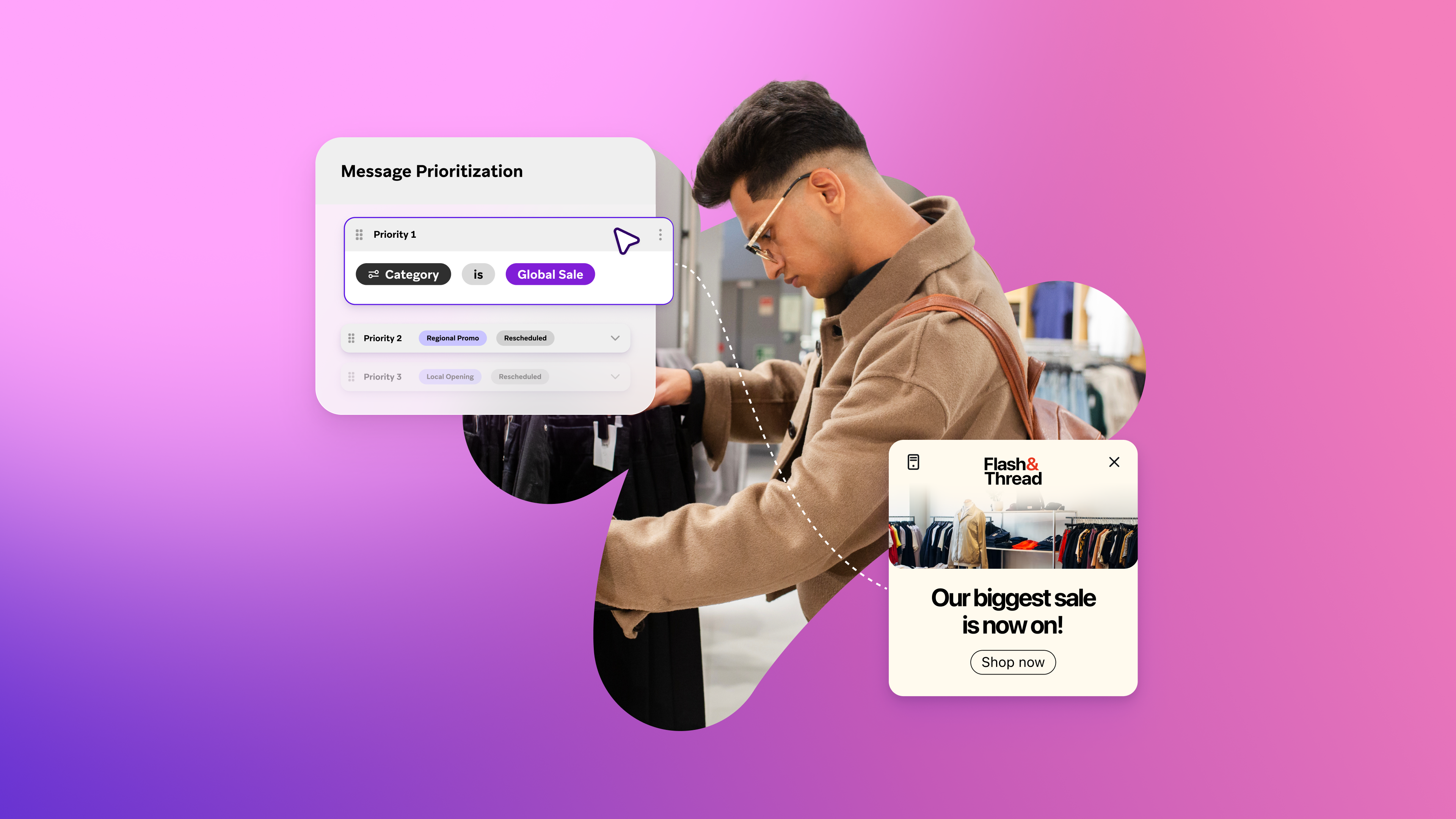
Message Prioritization: Make your most important messages win
October 20, 2026 Article37 min read
SMS marketing examples: Use cases for B2C brands, by industry
October 19, 2026 Article11 min read
BrazeAI Operator™ Use Cases: How Marketers Launch Campaigns, Build Segments, And QA In Minutes
October 19, 2026